It’s Not About Who is Right, It’s About What is Right.
We’re wired to win debates, to prove a point, to come out on top. In business, that instinct shows up in meetings, emails, reviews. But if you win the argument and pull people away from what’s right for the organisation, you haven’t really won.
Success built on alignment lasts longer than success built on ego.
This week’s 1‑1‑1 is a reminder: prioritise what’s right, not just who’s right.
Think about your last disagreement: were you defending your view or trying to arrive at the best decision for the organization?
How often do you drop your point once you see a better one on the table?
→ Remember: Maturity at work is when the business wins even if your idea doesn’t.
In one discussion this week (email, review, partner call), pause and ask: “What’s the right outcome for the company here?”
→ Do this now: Type/say it clearly “Let’s go with what’s best for the business.”
Arguing to win makes people defensive. Arguing to get to the best answer makes people trust the process.
→ Take this along: Don’t fight to be right, fight to get it right.
Thanks for reading!
Alkesh Agarwal


Hey! I’m Alkesh Agarwal.
An entrepreneur, investor & problem solver who loves taking big ideas and turning them into real businesses.
After years of building businesses, I’m here to share my experiences to help you navigate challenges faster, avoid mistakes, and build stronger.
Read: Crucial Conversations: Tools for Talking When Stakes Are High By: Kerry Patterson, Joseph Grenny, Ron McMillan.
Watch : “Why Good Leaders Make You Feel Safe” — Simon Sinek.
Tool to Try: Miro — Visual Collaboration Board.
Breakthroughs Are Born from Many Breakdowns
No founder wakes up chasing breakdowns. But ask anyone who’s built something that lasted and they’ll tell you: the breakthrough didn’t come despite the chaos, it came because of it.
Every business hits walls, some are operational, some emotional & some financial. In those moments it’s tempting to think something’s broken. But often, what’s breaking is a signal: a team that needs realignment, a product that needs pruning, a founder that needs to shift.
Breakdowns aren’t the end. They’re the invitation. To rebuild stronger. To rethink smarter. To realign with what actually works.
This week’s 1‑1‑1 is about leaning into the storm, not to suffer, but to surface your next bold move.
When something cracked recently, a failed pitch, a team fallout, a broken system, did you stop at frustration or look deeper?
→ Remember: Not all chaos is collapse. Some of it is a clue.
Pick one recent breakdown and ask: What was it trying to teach me? Write down three insights you’d never have seen if it hadn’t happened.
→ Do this now: Turn pain into process. That’s where leverage hides.
You can’t avoid every failure. But you can extract every lesson. And over time, those lessons stack into resilience, insight, and yes: breakthroughs.
→ Take this along: Don’t waste the breakdown. It’s where the leap begins.
Thanks for reading!
Alkesh Agarwal
Hey! I’m Alkesh Agarwal.
An entrepreneur, investor & problem solver who loves taking big ideas and turning them into real businesses.
After years of building businesses, I’m here to share my experiences to help you navigate challenges faster, avoid mistakes, and build stronger.
Read: The Obstacle Is the Way by Ryan Holiday — the timeless philosophy of turning trials into triumph.
Watch : “The Power of Vulnerability” by Brené Brown – how embracing discomfort fuels real growth.
Tool to Try: Post-Mortem Template: A quick reflection doc to turn breakdowns into structured insight.
Nothing Changes…Until Something Changes
It sounds obvious. But it’s also the truth most founders avoid. We keep running the same patterns, solving the same problems, blaming the same market.
And then wonder why we’re stuck.
Breakthroughs don’t just arrive. They’re created by changing one thought, one habit, one system. Staying stuck is easy. Change is effortful. But without change, there’s no movement, just motion.
This week’s 1‑1‑1 is your reminder: If you want different results then it’s time to make a different move.
Think of one area you’ve been stuck in revenue, team, mindset. Now ask: what’s actually changed in the way you approach it?
→ Remember: Stagnation isn’t a lack of ambition. It’s a lack of shift.
Pick a repeated pattern, how you start your mornings, run a meeting, structure sales, etc and disrupt it. Test something new this week.
→ Do this now: Change the default. That’s how momentum begins.
Massive shifts don’t always need massive effort. Sometimes, it’s just a consistent 1-degree turn that unlocks the bigger move.
→ Take this along: Progress starts the moment you stop repeating.
Thanks for reading!
Alkesh Agarwal
Hey! I’m Alkesh Agarwal.
An entrepreneur, investor & problem solver who loves taking big ideas and turning them into real businesses.
After years of building businesses, I’m here to share my experiences to help you navigate challenges faster, avoid mistakes, and build stronger.
Read: Atomic Habits by James Clear — powerful shifts start with micro-changes.
Watch : “How to Get Unstuck” by Adam Alter (TED Talk).
Tool to Try: The “Pattern Interrupt” Journal Prompt: Write one behavior you’re tired of, and what you’ll try differently this week.
Reset Is the Real Power Move
The day after Diwali always feels strange. The glow fades, the hustle quietens and the city that was bursting with light just 24 hours ago feels… still. There’s a silence that feels both comforting and disorienting, like the show is over and now, real life returns. And in that pause lies something powerful.
As entrepreneurs, we’re trained to keep pushing: harder, louder, brighter. But rarely are we taught the value of stepping back. Of letting the dust settle. Of rebuilding energy before the next sprint.
Resilience isn’t just built in constant motion. It’s forged in the stillness between bursts. The founders who last are not the ones who never stop, but the ones who know when to pause, reflect and reset.
This week’s 1-1-1 is a nudge to do just that: recover like it’s part of the plan because it is.
Think about your last big push, whether a campaign, product launch, or fundraising cycle. What did you do after it ended? Did you stop to breathe or rush into the next battle?
→ Remember: Recovery is a strategy, not an indulgence.
Block two hours this week with no meetings, no inputs, no outputs. Just space to review, reset, and realign. Let your nervous system catch up with your ambition.
→ Do this now: Create a reset plan and take the first step today.
What separates burnt-out founders from durable ones is not output, it’s recovery. The best don’t just push hard. They reset smartly.
→ Take this along: Step back now, so you can leap forward later.
Hope you all had a joyful, safe and meaningful Diwali.
Thanks for reading!
Alkesh Agarwal
Hey! I’m Alkesh Agarwal.
An entrepreneur, investor & problem solver who loves taking big ideas and turning them into real businesses.
After years of building businesses, I’m here to share my experiences to help you navigate challenges faster, avoid mistakes, and build stronger.
Learn What’s Worth Taking Seriously… And Laugh Off the Rest
In the night sky of entrepreneurship, not every meteor is a shooting star. Some look dramatic, even explosive but they’re just flares that fade fast.
You’ll face it all: urgent emails, unexpected crises, harsh feedback, shifting deadlines. Some of these will alter your course. Most won’t.
The real skill? Learning to tell the difference.
If you treat every spark like a fire, you’ll burn out. But if you ignore every flicker, you’ll miss the real warning signs.
This week’s 1-1-1 is about practicing discernment. Take seriously what truly moves the needle. Smile (and move on) from the rest.
Think about the last time you stressed over something that later seemed trivial. Did it deserve that energy? Or did your imagination amplify it?
→ Remember: Emotions exaggerate both promises and problems. Clarity comes when you pause before you panic.
Write down all the priorities, questions, and “urgent” items cluttering your mind right now. For each one, ask: “Is this critical or just tempting me to overreact?”
→ Do this now: Mark one thing as “serious” (must solve) and let one go, at least for today.
The levers you choose define your trajectory more than the ones you pull.
→ Take this along: Long-term impact comes not from reacting to everything but from focusing on the few that truly matter.
“We suffer more often in imagination than in reality.” — Seneca
Thanks for reading!
Alkesh Agarwal
Hey! I’m Alkesh Agarwal.
An entrepreneur, investor & problem solver who loves taking big ideas and turning them into real businesses.
After years of building businesses, I’m here to share my experiences to help you navigate challenges faster, avoid mistakes, and build stronger.
Love What You Do…
We’ve all heard of “Do What You Love”. Some of us have tried to chase it. And most of us, at some point, have felt guilty for not knowing what that even means.
Truth is, not everyone starts by doing what they love. Sometimes, you just start with a job that pays the bills, a business that happened by chance, or a responsibility that fell on your lap. You don’t always get to choose the work, but you can choose how you show up for it.
That’s the space where most of us live, figuring things out while still showing up every day. Till you find what you love, love what you do. Because when you start giving your best to what’s in front of you, you learn faster, grow deeper, and get closer to that clarity.
And somewhere along the way, you discover what you truly love and earn the right to do it.
So this week’s 1-1-1 is about shifting from chasing passion to creating it by loving what you do.
Think about the work you’re doing right now. Are you waiting for it to feel exciting before giving it your best? Or are you showing up fully, even when it feels ordinary? The truth is, love for your work often follows effort, not the other way around.
→ Remember: Fulfilment isn’t found in what you do—it’s created in how you do it.
Pick one task you usually hate or crib about—but still have to do because it’s part of your job. Instead of seeing it as a burden, see it as your chance to deliver something better than expected. You don’t need passion to start—just intention to do it well.
→ Do this now: Take one task you dislike today and finish it with care, not complaint. The difference won’t just show—it’ll shift you.
The more you honour what’s in front of you, the faster you reach what’s ahead of you. When you do even the unexciting work with intent, you quietly prepare yourself for the work that lights you up.
→ Take this along: Loving what you do today is how you earn what you love tomorrow.
“Real love doesn’t come from stories or spark. It grows when you spend time, make effort, and choose to stay curious about it every day.”
Thanks for reading!
Alkesh Agarwal
Hey! I’m Alkesh Agarwal.
An entrepreneur, investor & problem solver who loves taking big ideas and turning them into real businesses.
After years of building businesses, I’m here to share my experiences to help you navigate challenges faster, avoid mistakes, and build stronger.
Nothing is as good as it seems, nothing as bad either.
And the final quarter of the calendar year is here…a time when dreams feel urgent, regrets feel loud, and everything seems like it’s either falling apart or finally coming together.
Targets slip, markets wobble, and it feels like survival is at stake. Then a single contract lands and suddenly it feels like you’ve arrived. But that’s just emotions exaggerating, making both the highs and the lows feel bigger than they really are.
Highs and lows are part of every story, but our job is to keep steering through them.
Think back, did your highs really change everything? Did your lows really end you? Or did emotions just exaggerate both?
→ Remember: Our emotions distort the lens. What’s real is rarely as extreme as it seems.
Pick one high and one low from the last 90 days. Ask yourself: what story did I tell myself then, and what truth do I see now?
→ Do this now: Write one sentence for each: “Here’s what I thought then…” vs. “Here’s what I know now…”
A business isn’t built in fleeting highs or crushing lows. It’s built in steady steps that compound over time. What carries you forward isn’t the swings; it’s the discipline.
→ Take this along: Don’t let wins make you comfortable or challenges make you drift. To thrive, you need to show up every day with the same fire.
“Our greatest glory is not in never falling, but in rising every time we fall.” — Confucius
Thanks for reading!
Alkesh Agarwal
Hey! I’m Alkesh Agarwal.
An entrepreneur, investor & problem solver who loves taking big ideas and turning them into real businesses.
After years of building businesses, I’m here to share my experiences to help you navigate challenges faster, avoid mistakes, and build stronger.
Read: “Antifragile” by Nassim Nicholas Taleb — How systems (and people) benefit from stress and volatility.
Tool to Try: Maintain a “Reality Journal” — weekly check‑ins of what’s going well, what isn’t, and what you’re learning.
One year in, one truth stands taller than the rest—what doesn’t evolve, eventually dissolves.
After a year of showing up in your inbox every week, it was time for a change. Because in business (and in life), the moment we stop evolving… we start falling behind.
The world moves fast. What worked yesterday won’t win tomorrow. As entrepreneurs, we know this: change is constant but in the chaos of change, the core must stay intact. Keep what works. Let go of what doesn’t.
That’s exactly what we’ve done. We’ve evolved the look and turned up the energy. The format stays the same: One Reflection, One Action, One Takeaway but the packaging just got sharper.
And here we go…
Where in your business have you been doing things the “old way” simply because it’s “what’s worked before”? Are you holding on because it’s truly the best way, or simply because it feels comfortable?
→ Remember: Sticking with “what worked once” can become what holds you back tomorrow.
This week, pick just one area, maybe design, team communication, a product feature, or even how you touch base with customers and change one thing about it. Don’t overthink scale. Even the tiniest tweak can be enough to shake off stagnation and spark fresh energy.
→ Do this now: Write down that one area you’ll tweak this week and commit to making that change today.
Evolution isn’t about getting everything right. It’s about staying in motion. Every small iteration, no matter how imperfect, compounds into a stronger, more relevant version of what you do. Perfection slows you down, but momentum keeps you moving forward.
→ Take this along: Perfection is a pause button. Momentum is the play button. Always choose play.
Thanks for reading!
Alkesh Agarwal
Hey! I’m Alkesh Agarwal.
An entrepreneur, investor & problem solver who loves taking big ideas and turning them into real businesses.
After years of building businesses, I’m here to share my experiences to help you navigate challenges faster, avoid mistakes, and build stronger.
Read: “Refactoring UI ” by Adam Wathan & Steve Schoger — Great take on tweaking design for clarity and impact.
Watch :A short talk / video on adopting continuous improvement mindset (look for “Kaizen” themed videos).
Tool to Try: Trello or Notion template to map “What works / What doesn’t”.
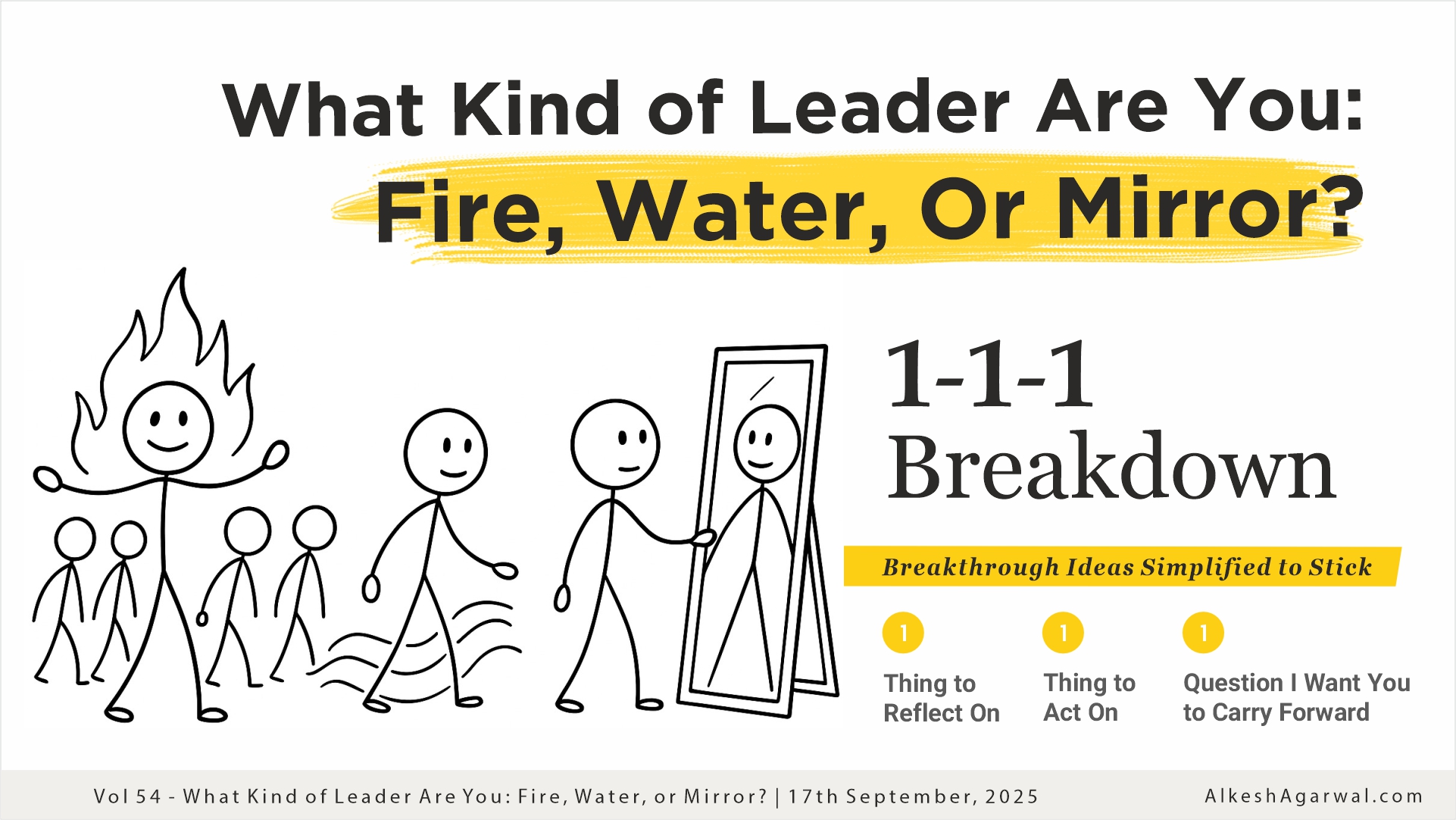
Every founder leads differently. Some are fire: intense, bold and action-oriented. Others are water: calm, adaptive and powerful. And then there are the mirrors: reflective, intentional, and focused on helping others see clearly.
There’s no right answer. But knowing your dominant style can help you lead better, communicate clearer, and build teams that complement, not copy you.
1-1-1 Breakdown: Fire, Water, or Mirror?
What’s your dominant leadership energy: do you ignite action, calm chaos, or reflect truth?
→ Awareness is power. Leaders don’t just act; they understand how their energy impacts others.
Balance your default style. If you’re fire, bring in water when tensions rise. If you’re water, be fire when urgency demands. If you’re a mirror, learn when to step into the spotlight.
→ Great leaders shift gears when the moment calls for it.
“Do people feel burnt, balanced, or seen after working with you?”
The Next Big Leap (NBL) Angle : Lead with Self-Awareness
Your Next Big Leap in leadership starts with knowing your energy and using it with intention. Influence isn’t about force. It’s about presence, awareness, and adaptability.
Thanks for Reading!
Hey! I’m Alkesh Agarwal.
An entrepreneur and investor who believes that as we dive into 2025, let’s take bold leaps, embrace growth, and focus on what truly matters – Health, Happiness, and meaningful progress. Here’s to making every step of the journey count!
Read: “Emotional Agility” by Susan David – Helps leaders understand and adapt their internal states, which is key to shifting between “fire, water, mirror” styles with awareness.
Watch : Susan David: The Gift and Power of Emotional Courage (TED Talk) – A powerful 16-minute talk on how self-awareness and emotional agility help leaders lead with presence and adaptability.
Tool to use : CliftonStrengths by Gallup – Helps you identify your dominant leadership energy and natural strengths so you can balance fire, water, and mirror when the moment calls.
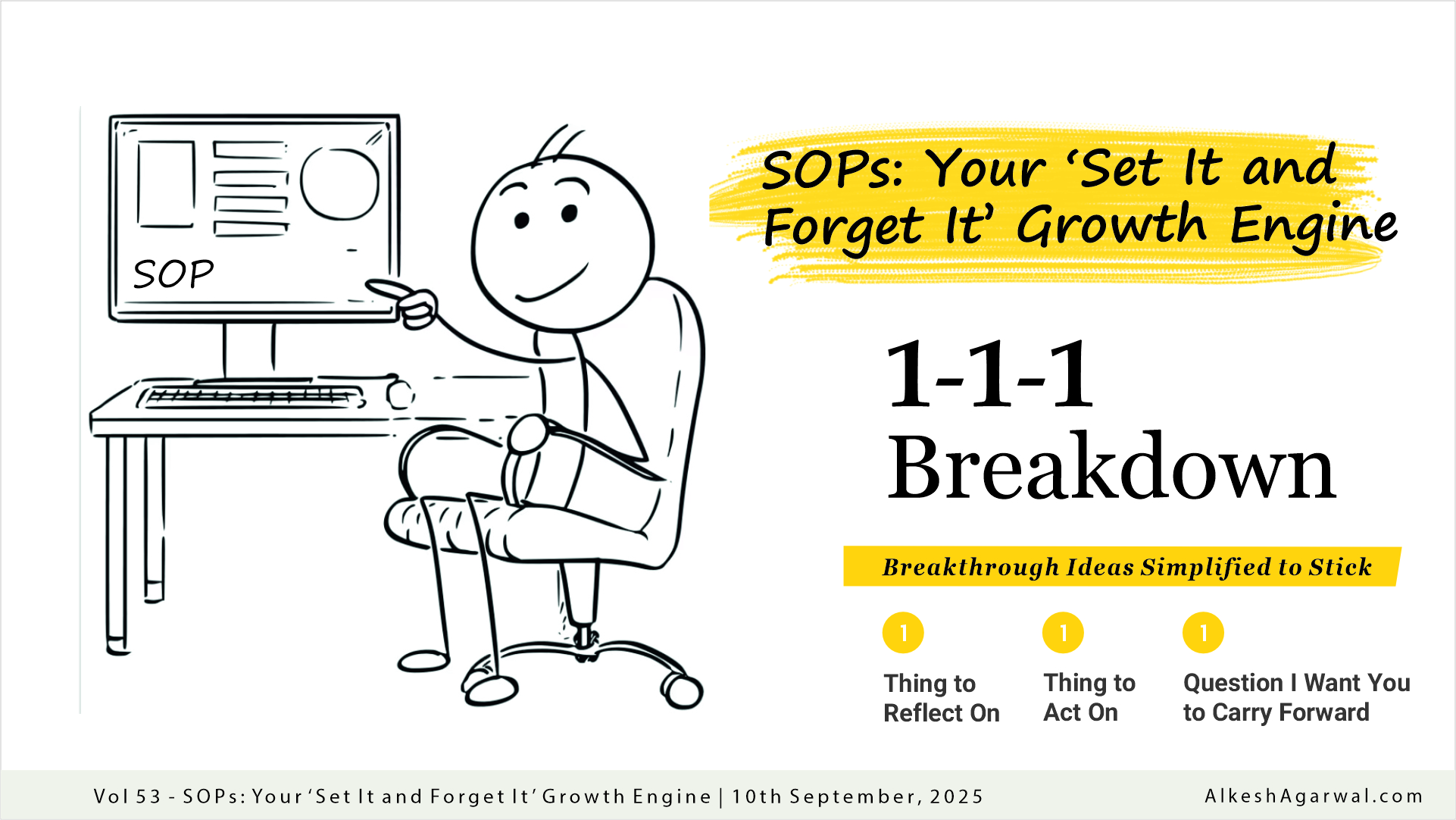
Every founder wants freedom. But here’s the trap: they chase it through hustle instead of systems.
In the early days, chaos is normal. You’re doing sales calls, writing emails, approving designs, following up with vendors—all in one day. But if that chaos becomes a habit, you’re not building a business. You’re building burnout.
The real shift? Replacing founder-dependence with founder-designed systems.
1-1-1 Breakdown: Scale Through Systems
Are you the bottleneck because there’s no system without you?
→ If your business pauses when you’re offline, you’re not leading—you’re holding it hostage.
Pick one task you do weekly. Record yourself doing it. Then document it and delegate it.
→ You don’t need to systemize everything. Start with one win.
“If your team doubled tomorrow—could they operate without calling you every hour?”
The Next Big Leap (NBL), Start Here: SOPs Are Your Exit Plan from Daily Chaos
Here’s a simple hack:
📄 Write down your ideal workday. Then ask: What tasks would I remove, delegate, or automate to make this real?
That becomes your blueprint. From there, document the first process. Train someone. Let it go. That’s your first SOP.
Thanks for Reading!
Hey! I’m Alkesh Agarwal.
An entrepreneur and investor who believes that as we dive into 2025, let’s take bold leaps, embrace growth, and focus on what truly matters – Health, Happiness, and meaningful progress. Here’s to making every step of the journey count!
Read: Work the System by Sam Carpenter — Master the art of building businesses that don’t rely on you.
Watch : How to Build Systems to Actually Achieve Your Goals (Leila Hormozi) — Practical systems to replace hustle with processes.
Try This Tool : ScribeHow — Tools to record and document your SOPs in minutes.